Why Business Leads Go Cold (And How AI Can Stop It)
The question worth asking: What happens to leads when no one follows up fast enough?
Most business owners we talk to assume their leads are bad. The harder question is: what happened in the first 5 minutes after that lead came in?
The 5-Minute Rule Most Businesses Have Never Heard Of
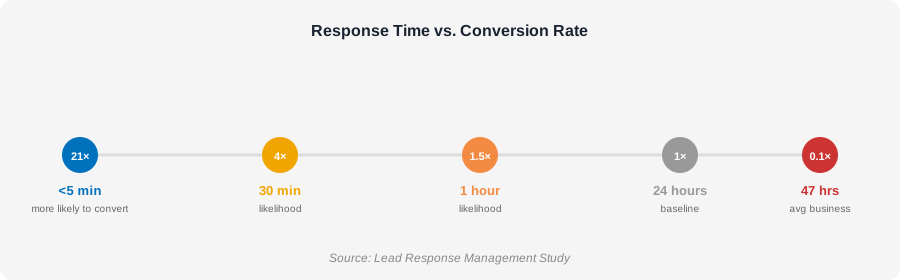
There's a stat that changes how most business owners think about their marketing spend: leads contacted within 5 minutes of submitting an inquiry are 21 times more likely to convert than those contacted after 30 minutes.
Not 21% more likely. 21 times.
That number comes from years of sales research, and yet the average business responds to a new lead in 47 hours — if they respond at all. In most cases, the prospect has already moved on. They've called someone else, submitted a form to three competitors, or simply forgotten they reached out.
The conversation you never had cost you a customer you already paid to acquire.
Why Manual Follow-Up Fails at Scale
It's not a staffing problem. It's a systems problem.
Manual follow-up depends on someone being available, attentive, and un-distracted at the exact moment a lead comes in — including evenings, weekends, and your busiest days. That's not a realistic standard for any team.
Here's what actually happens in most businesses without an automated follow-up system:
A lead submits a form at 7:42 PM on Friday
Nobody sees it until Monday morning
By then, two competitors have already followed up
Your first call goes to voicemail
The lead isn't cold because your product is wrong or your price is too high. It's cold because the window closed before you got there.
The problem isn't effort. It's timing.
What AI-Powered Lead Follow-Up Actually Looks Like
AI follow-up doesn't mean robotic messages that feel like spam. Done right, it means a personalized, conversational response that goes out within 60 seconds of a lead coming in — at any hour, any day.
Here's what a real sequence looks like for a home services business:
Immediate SMS (within 60 seconds): "Hi [Name], thanks for reaching out about [service]. I'm checking your availability now — what day works best for you?"
Email follow-up (5 minutes later): Branded, personalized email with service overview and a booking link
Second SMS (24 hours, if no reply): Gentle check-in with a different angle
Voice AI call (48 hours, if still no response): An AI agent that speaks naturally, answers basic questions, and books the appointment
Each touchpoint is logged to the CRM automatically. If the lead responds at any point, the sequence pauses and routes to a real person.
No leads fall through. No manual tracking. No Friday-night missed opportunities.
The Cost of Doing Nothing
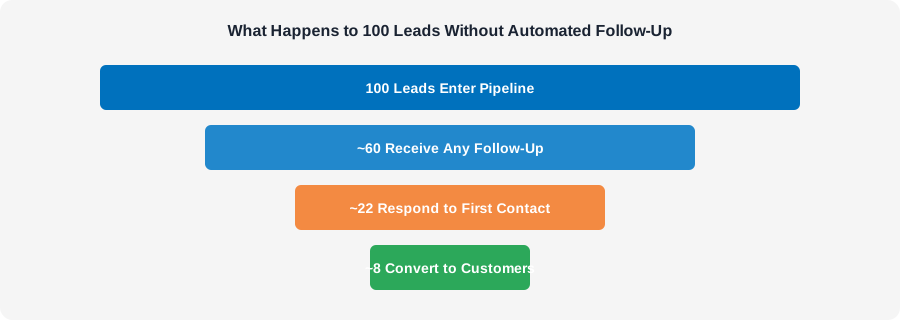
Consider a business spending $2,000/month on ads that generates 80 leads per month — $25 per lead. If 40% of those leads go unanswered or receive a slow response, that's 32 leads lost per month. At even a 25% close rate, that's 8 customers never acquired.
If your average customer is worth $500, that's $4,000 in lost revenue from a $2,000 ad spend — not because the ads didn't work, but because the follow-up didn't.
The question isn't whether you can afford AI follow-up. It's whether you can afford not to have it.
How to Know If This Is Your Problem
Ask yourself these questions:
Do you know exactly how long your average lead waits before first contact?
Can your business respond to leads at 9 PM on a Sunday?
Do you have a documented, consistent follow-up sequence — or does it depend on whoever is available?
How many leads in your CRM are marked "no response" or haven't been touched in 30+ days?
If any of those questions made you uncomfortable, the gap is likely costing you more than you realize.
What to Do Next
Fixing this doesn't require a massive overhaul. It requires three things:
A CRM that captures every lead in one place — regardless of where it came from
An automated sequence that fires the moment a lead enters — SMS, email, or both
An AI agent for after-hours and overflow — so no lead waits more than 60 seconds
These aren't futuristic tools. They're available today, and businesses using them consistently outperform those that don't on conversion rate, cost per acquisition, and customer lifetime value.
The leads aren't the problem. The gap between lead and contact is. And that gap is now completely closable.
---
Frequently Asked Questions
How fast should a business respond to a new lead?
Research consistently shows that responding within 5 minutes dramatically increases conversion rates — up to 21x compared to a 30-minute response. Ideally, an automated response fires within 60 seconds, with a human follow-up as soon as possible during business hours.
Can AI really replace human follow-up for sales leads?
AI doesn't replace human follow-up — it handles the immediate response and qualification so that by the time a human makes contact, the lead is already engaged and expecting the call. It eliminates the dead zone between inquiry and contact.
What is speed-to-lead and why does it matter?
Speed-to-lead is the time between when a prospect submits an inquiry and when they receive their first contact. It's one of the strongest predictors of whether that lead will convert, because prospects are at peak interest the moment they reach out.
---
Ready to close the gaps in your marketing? Book a free strategy call with Mixed Digital and we'll show you exactly where your biggest opportunity is.
